


Members of University of Guelph-Humber and Humber Polytechnic’s Student Union IGNITE are worried about the future of its funding.
Emily Edwards and Selena Ferreira are student advocates for IGNITE. They are concerned about the campus services that could be impacted because of new provincial legislation.
Bill 33, also called the Supporting Children and Students Act was passed in November 2025. It is a law that covers different areas of education that affect children and youth. But only a small subsection within the law details the implications for colleges and universities.
“This bill would give the government control over student fees, which fund very important things that students access daily. So that can be mental health resources, clubs on campus, the IGNITE Soup Bar,” says Edwards.
According to statistics provided by IGNITE in an email, during the 2024 – 2025 school year, the IGNITE SoupBar had served 12,062 soups to students. Other services include the IGNITE Tax Clinic and IGNITE’s Zen Zone.
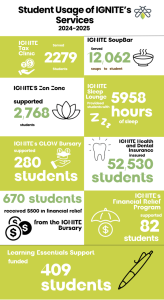
Student Usage of IGNITE Services for the 2024-2025 school year.
Infographic made by Smeen Javed, statistics provided by IGNITE.
IGNITE is worried about two sections of the law in particular that pertain to auxiliary fees and the merit based admissions.
Olivia Villeneuve is the manager of policy, research and government relations at the College Student Alliance (CSA). She says auxiliary fees fund student services such as academic support, athletic departments and the IGNITE SoupBar at Humber.
Villeneuve worries about the government’s ability to dictate “which student services are essential.” She compares this legislation to the 2019 Student Choice Initiative.
That legislation covered non-essential services that required institutions to allow students to opt out of those fees. The Ontario Court of Appeal overturned that law in the same year. Villeneuve says the wording for Bill 33 is similar to the Student Choice Initiative’s and fears control of student fees.
Examples of common non mandatory fees are health and dental insurance or transit passes. Villeneuve feels that opting out of those types of fees could delay access to other services and affect the stability of student unions.
“The difficulty with this process is that it creates a system where student unions are not able to predict where their funding is coming from every year,” says Villeneuve.
Borden Ladner Gervais, a Canadian law firm, says in an article that the legislation’s aim for oversight of auxiliary fees is to increase transparency and trust between students, unions and institutions by standardizing fees and allowing students to opt out of paying fees for services that are not mandatory.
Villeneuve says this won’t work well because each campus has unique services. She gives the example of campuses that have commuter students who need bus passes versus campuses that have more of an “on campus community,” and require mental health and wellness services.
“it’s hard to say what is essential to every student all across the province. When really the needs change from campus to campus and even from year to year based on the student body,” says Villeneuve.
At the end of February the CSA will be meeting with the Ministry of Colleges, Universities, Research Excellence and Security to present the student perspective, as well as present student responses from the student feedback form for Bill 33. At the point of publication, the survey is still open to students who wish to complete it.
Villeneuve says that the majority of the responses express concerns around a lack of student services and what makes up a campus community. The concern also stem from the recent cuts to staff, support staff and programs across Ontario. Though, there are some students who say that the bill will be beneficial in increasing transparency as they feel fees are too high and are not being properly informed about where their money is being spent.
IGNITE’s second concern is about merit based admissions, which Villeneuve calls vague and lacking clear terms and goals.
“What we’re pushing for is just to make sure that the way that merit is defined is very inclusive and very representative,” says Villeneuve.
Emerge contacted the Parliamentary Assistant to the Minister of Education, Billy Pangco, for an interview about Bill 33 but in an email was told “he is unable to participate in interviews on this matter.”